


International collaboration on mind and brain research
Blended Intensive Programmes (BIPs) are an Erasmus+ initiative that bring together students and academics from partner universities across Europe to explore different themes through a learning experience comprising a virtual part and a shorter physical mobility.
In June 2026, the Department of Psychology co-organized the BIP-programme under the theme Individual Differences in Mind and Brain, with both faculty members and students participating alongside colleagues from across Europe. Partner universities were Università degli Studi 'G. d'Annunzio' Chieti and Instituto Universitário de Lisboa.
Bringing together master's and PhD students, researchers and teaching staff, the programme explored individual variation in thinking, behavior, and brain function through an interdisciplinary lens. Combining online seminars with an intensive study week in Chieti, Italy, participants took part in lectures, workshops and academic discussions at the intersection of psychology and neuroscience.
The programme provided a valuable opportunity for international collaboration, knowledge exchange and engagement with leading researchers in the field, while enabling participants to earn 3 ECTS credits.
A warm welcome and new academic perspectives
One of the participants this June was Thomas Jack Samuels, doctoral student at the Department of Psychology:
– I was motivated to go by the perfect blend of the topic, people and setting. It seemed like an ideal fit to inform my PhD work, and that, coupled with the chance to travel with dear colleagues, explore potential collaborations, and strike up new friendships, made it an offer I could not refuse.
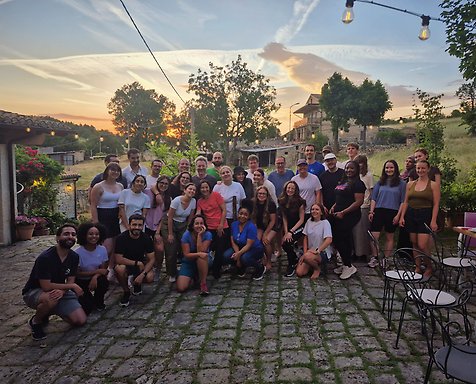
The group. Photo: Private
Did the experience live up to your expectations?
– It certainly did. I would say warmth would be the word that captures the experience best. Not only was the weather glorious, literally very warm, but the figurative warmth, the openness and hospitality shown to us by our hosts and fellow attendees, was just as wonderful. The course content was varied, and I felt it had something for almost anyone. It even surpassed my expectations, as I developed a previously untapped interest in individual variability in brain morphology, a topic well outside my usual area of focus and one in which I have little prior experience.
What are your greatest take aways from the experience?
– Professionally, I gained real insight into how researchers from different domains weave individual differences into their thinking. In particular, the workshops and seminars on multilevel modelling inspired me to integrate a similar analytical workflow into my own work on nonverbal coordination, where I have primarily focused on group-level averages until now rather than modelling how individuals vary in terms of their coordination patterns.
What is important to keep in mind when it comes to the topic Individual Differences in Mind and Brain?
– I think that shifting the focus to interpersonal variability, as encapsulated in Professor Håkan Fischer's keynote lecture, may be the key to better understanding humans and designing interventions that really work at the individual level. Group-level studies risk washing out that variability, and the resulting aggregate estimates may not correspond to any real-world individual or phenomenon, meaning that any application of these findings could be severely limited.
Last updated: 2026-09-29
Source: Department of Psychology