


Cultural Evolution in the Age of AI: Genes, Memes, and Machines
Joanna Bryson, Hertie School, Berlin, will talk about Darwin Dawkins Meme: AI and the Future of Evolution, and Levin Brinkmann, Max Planck Institute for Human Development, Berlin, will talk about Cultural Evolution of Humans and Machines.
The Centre for Cultural Evolution is hosting today's symposium. Contact: Fredrik Jansson, fredrik.jansson@su.se.
Welcome!
Programme
14:00–15:00
Joanna Bryson: Darwin Dawkins Meme: AI and the Future of Evolution
Explores why humans have developed such complex cultures and how artificial intelligence may transform the relationship between biological and cultural evolution.
15:15–16:15
Levin Brinkmann: Cultural Evolution of Humans and Machines
Examines how AI influences human culture and how cultural evolution among AI agents can give rise to cooperation or defection.
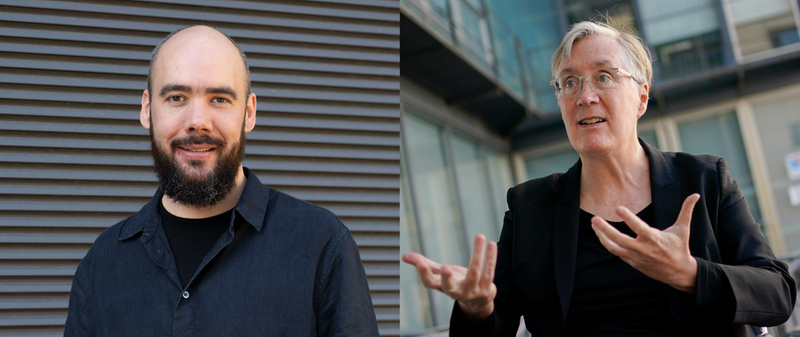
Levin Brinkmann och Joanna Bryson.
Presentations
Joanna Bryson is Professor of Ethics and Technology at the Hertie School in Berlin. She has worked on the ethical and societal implications of AI since the 1990s, and her research spans natural and artificial intelligence, cognition, human cooperation, AI governance, and public policy.
Levin Brinkmann is a computational social scientist at the Center for Humans and Machines at the MPI for Human Development in Berlin, focusing on complex systems, human–AI interaction, collective intelligence, and the emergence of machine culture.
Read more about Levin Brinkmann
Abstract (Bryson)
Why do humans have substantially more built culture than any other species? This talk explains both the dual replicator theory and Hamilton's Law explaining altruism to help us understand our culture. We then deploy this understanding to predict possible outcomes if memes outstrip genes through artificial intelligence.
Abstract (Brinkmann)
AI systems are becoming participants in cultural evolution. They pass new strategies and ways of speaking on to humans, and they increasingly form populations with cultural dynamics of their own.
I will briefly show how machine-discovered strategies and chatbot language spread through human populations. I will then focus on cultural evolution among machines: populations of LLM agents that play social dilemmas and pass their instructions on to the next generation. Whether selection acts on individuals or on groups makes the difference between stable cooperation and collective defection. I will discuss how cultural evolution theory can inform us about the hybrid society.
Last updated: 2026-11-06
Source: Department of Psychology