


Workshop on rare scripts strengthens the dialogue between humanists and computer scientists
The workshop ”Philology Meets AI: Deciphering Rare Scripts” explored how AI and computer vision can support the analysis of historical writings while remaining grounded in philological expertise.
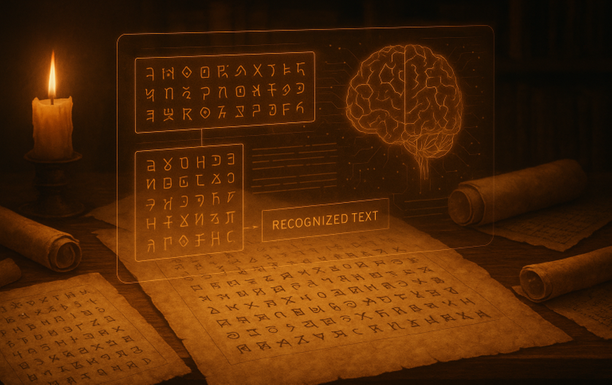
Illustration: ChatGPT
The workshop was held at Stockholm University on May 4, 2026, bringing together researchers from philology, linguistics, palaeography, epigraphy, cryptology, natural language processing, computer vision, and AI.
With almost 45 registered participants on site and around 40 joining online from around the world, the event showed strong international interest in the study of rare, fragmented, and undeciphered writing systems and scripts.
A key message of the day was that rare scripts require both computational support and humanistic interpretation
A key message of the day was that rare scripts require both computational support and humanistic interpretation. Talks covered rare scripts of the world, the relation between language and writing, shorthand and artificial writing systems, computational transcription, automatic decipherment tools, and case studies on Linear Elamite and Proto-Elamite.
AI methods must be combined with philological expertise
“The workshop demonstrated how crucial it is to combine philological expertise with modern AI methods”, says Beáta Megyesi, Professor at Stockholm University and the main organizer of the workshop. “For rare and fragmentary writing systems, both technical tools and deep humanistic knowledge are needed to interpret the material responsibly.”
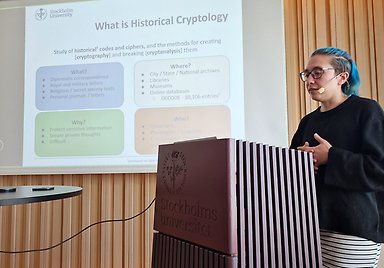
Micaella Bruton, Department of Linguistics, Stockholm University, talks about the decipherment of ciphers with neural models. Photo: Crina Tudor
AI can help scale transcription, comparison, and hypothesis generation, but philology remains essential for defining the data, interpreting uncertainty, and understanding cultural and historical context.
The National Graduate School in Digital Philology highlighted the breadth of ongoing research
An important part of the workshop was the presentations by the National Graduate School in Digital Philology, which highlighted the breadth of ongoing research on historical writings and rare scripts.
“Their work on ciphers, Pictish symbols, Linear Elamite, runic inscriptions, and Ajami manuscripts contributed significantly to the discussion on how philological methods and digital tools can be developed together,” says Beáta Megyesi.
During the day, PhD students also presented their ongoing research.
The workshop strengthened the dialogue between humanists and computer scientists, and laid the groundwork for further collaboration within the DESCRYPT project ”Echoes of History: Analysis and Decipherment of Historical Writings” and future events.
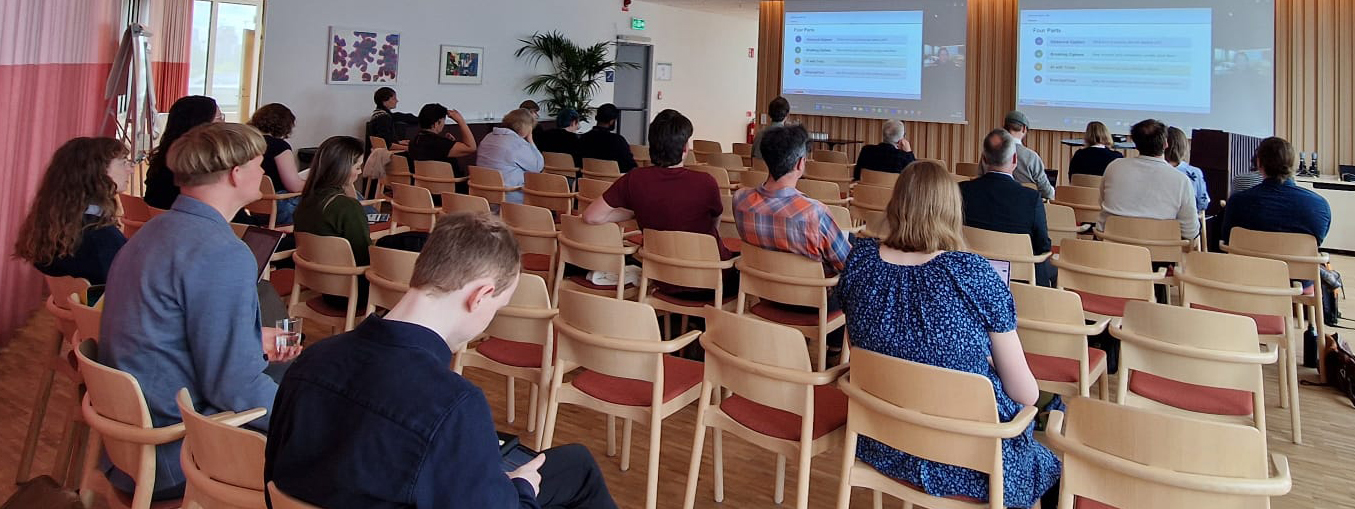
The workshop brought together 45 participants on site — and nearly as many online from different parts of the world. Photo: Crina Tudor
The workshop ”Philology Meets AI: Deciphering Rare Scripts” was organized by Beáta Megyesi and Crina Tudor at Stockholm University together with Michelle Waldispühl at the University of Oslo, within the framework of the DESCRYPT project ”Echoes of History: Analysis and Decipherment of Historical Writings”, in cooperation with the National Graduate School of Digital Philology.
More information about the workshop, invited speakers and program. pdf, 250.7 kB.
Last updated: 2026-06-01
Source: Department of Linguistics