


What shapes the welfare state? New book compares Sweden and South Korea
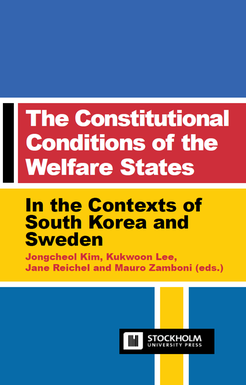
Sweden and South Korea have taken different paths in building their welfare states. In a new open-access edited volume, researchers from the two countries explore how constitutions, societies and political developments have shaped social rights and welfare policy.

A woman looks out over Seoul, the capital of South Korea. The South Korean welfare state has developed in a different historical and socioeconomic context from that of Sweden. Photo: Nikolai Tsuguliev/Mostphotos.
The ideal of the welfare state embodies the aspiration for a collective existence and shared prosperity among all citizens.
— Introduction, The Constitutional Conditions of the Welfare States,
Jongcheol Kim, Kukwoon Lee, Jane Reichel och Mauro Zamboni
A central question in The Constitutional Conditions of the Welfare States: In the Contexts of South Korea and Sweden is what role constitutions play in shaping welfare policy. Constitutions establish the basic framework for how the state is governed, how power is distributed and how citizens’ rights are protected. But what role do they play in practice in shaping the welfare state and determining the extent to which social rights can be realised?
The book approaches this question from several perspectives, examining different areas of the welfare state, including labour law, social insurance and education. The authors also explore how legal and political institutions interact in shaping, interpreting and implementing social rights.
Two different paths to the welfare state
The comparison between Sweden and South Korea highlights two distinct paths to the welfare states we see today. The Swedish welfare state has developed over a long period, while social rights have been relatively weakly entrenched in the constitution. In South Korea, the welfare state developed more recently, particularly in the context of democratisation from the 1980s onwards and major socioeconomic changes.
By comparing the two countries, the book sheds light on how legal, political and institutional conditions shape the development of the welfare state. It also highlights different ways in which social rights can be strengthened and social justice promoted.
A Swedish-Korean research collaboration
The volume is edited by Jongcheol Kim of the School of Law at Yonsei University in Seoul, Kukwoon Lee of the School of Law at Handong Global University, South Korea, and Jane Reichel and Mauro Zamboni of the Faculty of Law at Stockholm University, Sweden.
The book is the result of an international and interdisciplinary research collaboration involving twelve scholars with different perspectives on constitutional law, welfare and social rights. The collaboration was funded by the Swedish Foundation for International Cooperation in Research and Higher Education (STINT). By bringing together experiences from two countries with distinct historical, political and legal contexts, the volume contributes to a deeper understanding of the development of the welfare state and the role of constitutional law in advancing social justice.
The publication is aimed at researchers, students and others interested in constitutional law, social rights and the development of the welfare state. It is freely available in electronic form through Stockholm University Press at Stockholm University Library.
A new open-access book series
The Constitutional Conditions of the Welfare States is the first book in the Stockholm Law Series, the latest addition to the Faculty of Law’s series of scholarly publications. The series is published in collaboration between the Foundation Publications Issued by the Faculty of Law at Stockholm University and Stockholm University Press at Stockholm University Library.
The Stockholm Law Series publishes legal scholarship and course literature in Swedish, other Scandinavian languages and English. Through open access, the books are freely available to read and download in electronic form, allowing the research to reach readers both within and beyond academia.
Text: Natalie Oliwsson
Last updated: 2026-09-18
Source: Department of Law