


Desire lines reshape Stockholm's modernist park landscapes
Researchers Andrew Byerley and Ulf Jansson at the Department of Human Geograpy have published a new study examining how informal footpaths have transformed Rålambshovsparken in Stockholm over nearly a century.
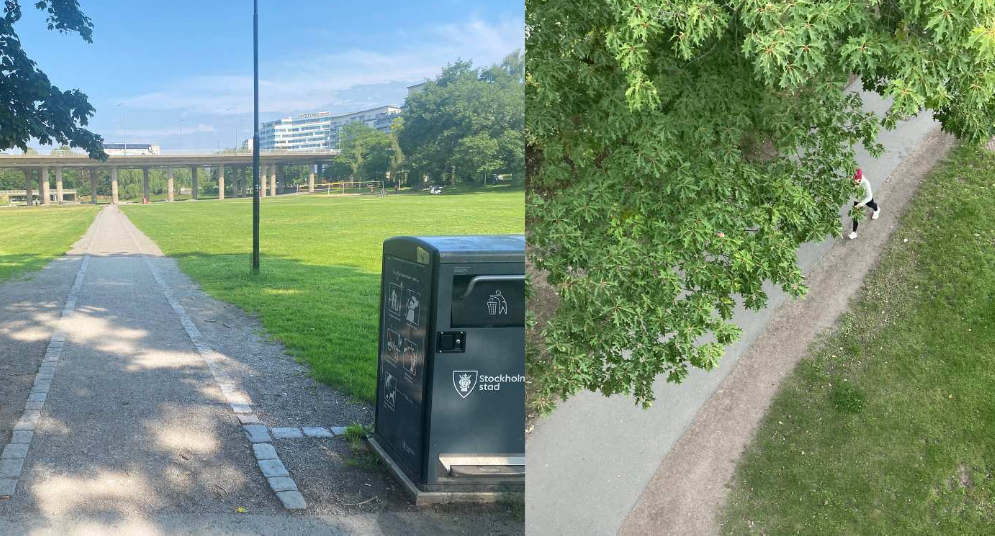
Not all desire lines are shortcuts, as these examples show. Some are created immediately adjacent to a formalized desire line (left photo) and adjacent to an original formal path (right photo). Photos by Ulf Jansson (left) and Andrew Byerley (right), 2025.
In their article, published in Geografiska Annaler: Series B, Human Geography, Byerley and Jansson investigate so-called desire lines—informal paths created when people walk outside planned routes. Focusing on Rålambshovsparken, a modernist “Stockholm Style” park established in the 1930s, the researchers trace how these paths have emerged, changed and been managed from the park’s establishment to the present day.
The study combines field mapping, aerial photography, archival research and interviews with landscape architects. This longitudinal approach identifies four periods in the development of the park’s informal-formal path network, or “path meshwork”. Byerley and Jansson show that desire lines are not simply shortcuts or signs of resistance to formal planning. They can serve several functions, including connecting destinations, providing alternative surfaces for activities such as jogging, and offering shelter or other spatial advantages.
The article also presents an experimental typology of desire lines, ranging from informal walking threads and traces to paths that have been partially or fully formalised. The analysis demonstrates that these lines can become incorporated into official park infrastructure, while others may be fenced off or removed—sometimes only to reappear later.
Byerley and Jansson argue that everyday walking practices actively co-produce and co-design urban green spaces. Over time, the accumulation of desire lines has increased connectivity and walkability in Rålambshovsparken while also fragmenting the park’s originally open grass surfaces. This creates planning dilemmas concerning which paths should be formalised, which should be removed and how the park’s historical character can be balanced against contemporary patterns of use.
The authors conclude that desire lines should be recognised as an important, yet often overlooked, part of urban walking infrastructure. They call for further comparative research into how informal footpaths shape parks and other urban environments in different geographical and planning contexts.
Read the article:
Byerley, A., & Jansson, U. (2026). Mapping disobedient footwork: Desire lines as co-producers of path meshworks and green surfaces in a modernist urban park in Stockholm. Geografiska Annaler: Series B, Human Geography. https://doi.org/10.1080/04353684.2026.2737858
Andrew Byerley is Senior Lecturer, Docent at the Department of Human Geography.
Ulf Jansson is Senior Lecturer at the Department of Human Geography.
Last updated: 2026-09-30
Source: Department of Human Geography