


New Article: Spatial Processes of Habitus Formation Among Young Adults in Suburban Stockholm
Eva Andersson and Bo Malmberg, professors in Human Geography at Stockholm University have together with Sara Forsberg at Uppsala University published a new article in International Journal of Urban and Regional Research on how young adults’ life trajectories are shaped by their local environments in southern Stockholm.
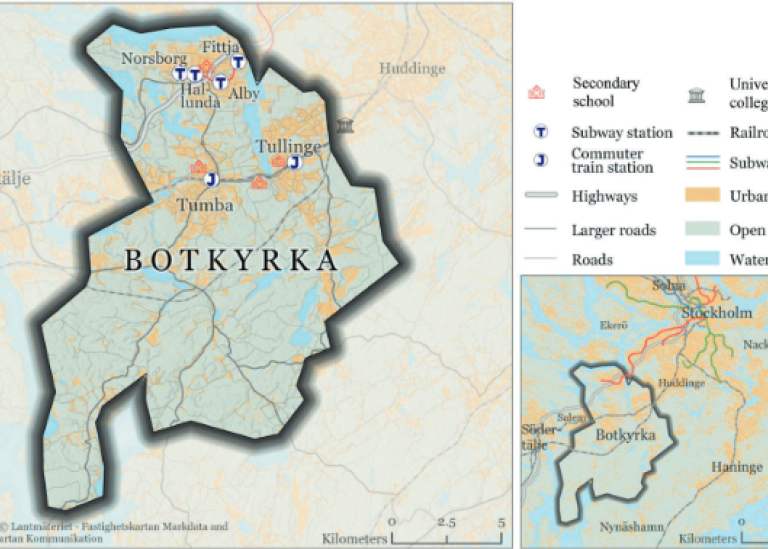
Map over Botkyrka in southern Stockholm.
The study examines how the places young people grow up in influence the opportunities they perceive for their future. By combining statistical analysis with interviews with upper secondary students aged 17–19, the researchers reveal that local contexts significantly shape young people’s life plans and expectations.
Drawing on social theories from Pierre Bourdieu, Loïc Wacquant and Doreen Massey, the authors identify four key spatial processes behind the formation of life paths:
- The broader social structures that divide southern Stockholm along lines of affluence and vulnerability;
- Symbolic images that make some schools visible and attractive while rendering others invisible;
- Social encounters (and non-encounters) that occur across home, school, and leisure spaces;
- The varying layers of local settings and social networks, which connect differently to national institutions and shape young people’s horizons of opportunity.
The study’s mixed-methods approach contributes to neighbourhood research by revealing the multiple ways that place is embedded in life course formation – and how spatial inequalities continue to shape youth transitions in contemporary urban settings.
Read the article in International Journal of Urban and Regional Research: Spatial Processes of Habitus Formation Among Young Adults in Suburban Stockholm
Last updated: 2025-04-23
Source: Department of Human Geography