


Aaron Hughes: "We must ask ourselves what the humanities are for"
In 2026, ERG will host Aaron Hughes, an internationally renowned scholar of the history of religions who currently serves as the Philip S. Bernstein Professor of religion and the Dean’s Professor of the humanities at the University of Rochester in New York.
Professor Hughes is known for his comparative, rigorously evidence-based, and historically grounded approach to the history of religions. He is an outspoken critic of identity-based and confessional perspectives within the discipline and will serve as an important international ally with the potential to strengthen Swedish critical humanities research at a time when both apologetic and activist orientations threaten academic independence. Aaron Hughes’s visit to the Department of Ethnology, History of Religions, and Gender Studies is funded by the Swedish Research Council’s call for proposals for international visiting professors.
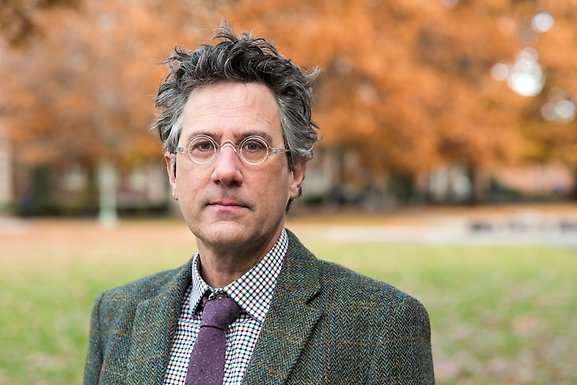
Aaron Hughes. Photo: J. Adam Fenster
Professor Hughes, welcome to Stockholm University and the Department of Ethnology, History of Religions, and Gender Studies! We are very pleased and grateful that you have agreed to be our visiting professor in 2026 and look forward to an exciting collaboration. What did you envision when you decided to accept the position as our visiting professor, and what do you hope to gain from your time here?
- Thank you very much for this welcome. It is a delight to be here, and I look forward to being a part of and contributing meaningfully to the department. What do I envision and hope to gain during my time here? These are two difficult questions. Without being vague, I come with an open mind and the hope for intellectual possibilities that I cannot even imagine yet. I have had a productive last few years and have three monographs that either just came out or are about to appear and another three that are currently undergoing peer review. I say this not to brag, but to maybe give you a sense of my state of mind. I have a few ideas about a next project, but am not in any rush to begin anything immediately. I instead want to immerse myself in a new intellectual environment and interact with Swedish colleagues and students to take me away from my own thinking, which, like all thinking, can become habituated. This helps us to see things in new light and, perhaps most importantly, to think collectively with like-minded colleagues about shared projects and collaborations. So, I want to read, to talk and to listen, and not necessarily in that order.
I want to immerse myself in a new intellectual environment and interact with Swedish colleagues and students to take me away from my own thinking, which, like all thinking, can become habituated.
Do you have any prior connection to Sweden or Swedish research in the history of religions?
- I can answer this in at least two ways. The first is that I have been coming to Sweden regularly over the past few years and engaging with colleagues in Stockholm, Lund and Umeå. Part of this work involves the inter-university doctoral programme in Islamic studies and I have watched several of the students’ projects in the programme develop over the last few years. Relatedly, I have always found camaraderie with Swedish colleagues as many of them, like me, are trying to ascertain what a critical study of Islam might look like and have found the larger field of religious studies as a convenient way to do this. So, I think it fair to say that we have a shared intellectual heritage that we both draw on.

Mecca. Photo: GLady / Pixabay
- Secondly, I come from the largest northernmost city in North America—Edmonton, Alberta in western Canada. growing up we had hockey tournaments and music and other arts festivals with Scandinavian countries. I also like to think that Swedes and Canadians share a similar worldview when it comes to the state and the nature of liberal democracy. Since Edmonton is only a few degrees south of Stockholm, there is a rather familiar flora and fauna, to say nothing of the quality of light. So, Stockholm does not seem wholly unfamiliar to me from a geographical perspective.
In Sweden, the academic world is currently facing certain challenges, as the social climate has stirred up forces that in various ways challenge academic freedom and scientific independence. There are common problems across disciplinary boundaries, but also specific challenges for individual disciplines. Is this something you recognize, and if so, what do you consider to be the primary threats to academic freedom within the history of religions?
- I don’t think any of this is unique to Sweden and the Scandinavian countries. Though I am Canadian I work at a university just over the border from Toronto in New York State. The neo-liberal university, it seems to me, has emerged in the American context from which it has been imported to numerous liberal western democracies and where it plays out in various local contexts. I cannot speak to the Swedish example of this because I have not been here long enough. However, if it is like anything in the U.S. then I can say that we are on the precipice of much change. I guess the question is: will we be able to adapt and change with the times? We must further ask ourselves a series of questions that we perhaps should have entertained years ago: What are the humanities for? How do they relate to the concerns of citizens, taxpayers and other stakeholders? It strikes me that the conversation around this might be more robust in Sweden than it is in the U.S. and Canada, but I hope to find out more in the coming months. I will say, though, that the curtailing of free speech that the U.S. is currently going through is problematic, especially for those of us who work in Islamic studies.
I have always found camaraderie with Swedish colleagues as many of them, like me, are trying to ascertain what a critical study of Islam might look like and have found the larger field of religious studies as a convenient way to do this.
- While I certainly think such prohibitions will pass, as these things inevitably do, an even bigger concern is the role of generative AI platforms and what this will mean not just for our students, but also our own research (especially in the humanities). I worry it will lead to a flattening of human expression and creativity, which are two of the hallmarks of both teaching and humanistic scholarship. What does it mean, perhaps stated more concretely, to not know Arabic and to have never lived within a Muslim environment to suddenly be able to click a button that translates immediately an Arabic corpus that one can write a doctoral thesis on or a book?
In your extensive research, among other things, you have highlighted the significance of literary form for religious writings. Could you briefly share what interests you about linguistic form and why studying this is significant within the history of religions?
- That is interesting. I don’t know if I would have called this a highlight of my research, but the more I think about it, I can see what you mean. When I was younger, I used to think philosophers had answers to help unlock the difficulties of life. But the older I get, the more I find philosophy to be too technical and too removed from life. Increasingly, I take solace (and answers) in literature and in music. Literature gives us a set of narratives and music provides a soundtrack to help us deal with the difficulties and beauty of what it means to be human. And, to answer the question, the more I think about it, the more I think about the importance of story-telling as a method. I have been working on a monograph on decolonizing Islamic studies, and I have been reading quite a lot on what we call, at least in Canada, Indigenous studies. The latter field, it seems to me, has elevated story-telling to a methodology as a way to establish narrative sovereignty. By this they mean that communities possess an inherent right and power to control, create, and define their own stories, histories, and representations. This helps them dictate how they are portrayed, and often in a manner that directly counters colonial narratives, stereotypes, and misrepresentations. And, to be honest, I am trying to figure out what all this means for Islamic studies, for the history of religions, and for the humanities more broadly. We are, after all, story-tellers, but many of us in the academy have forgotten that.

Photo: Katharina Kammermann / Pixabay
Beyond your work as a visiting scholar here in 2026, is there anything else you’d like to do during your visit to Stockholm and Sweden?
- Well, I am a big fan of football, hockey and live music. And I certainly know that Stockholm is well-known for all three. As a western Canadian, I also like to spend time in nature. So I am hoping to engage all of these pastimes.
Last updated: 2026-04-14
Source: Department of Ethnology, History of Religions and Gender Studies