


Disputation in International Relations - Axel Nordenstam
On April 24, 2026, Axel Nordenstam successfully defended his dissertation 'India's Green Status Dilemma - A Practice Approach'.
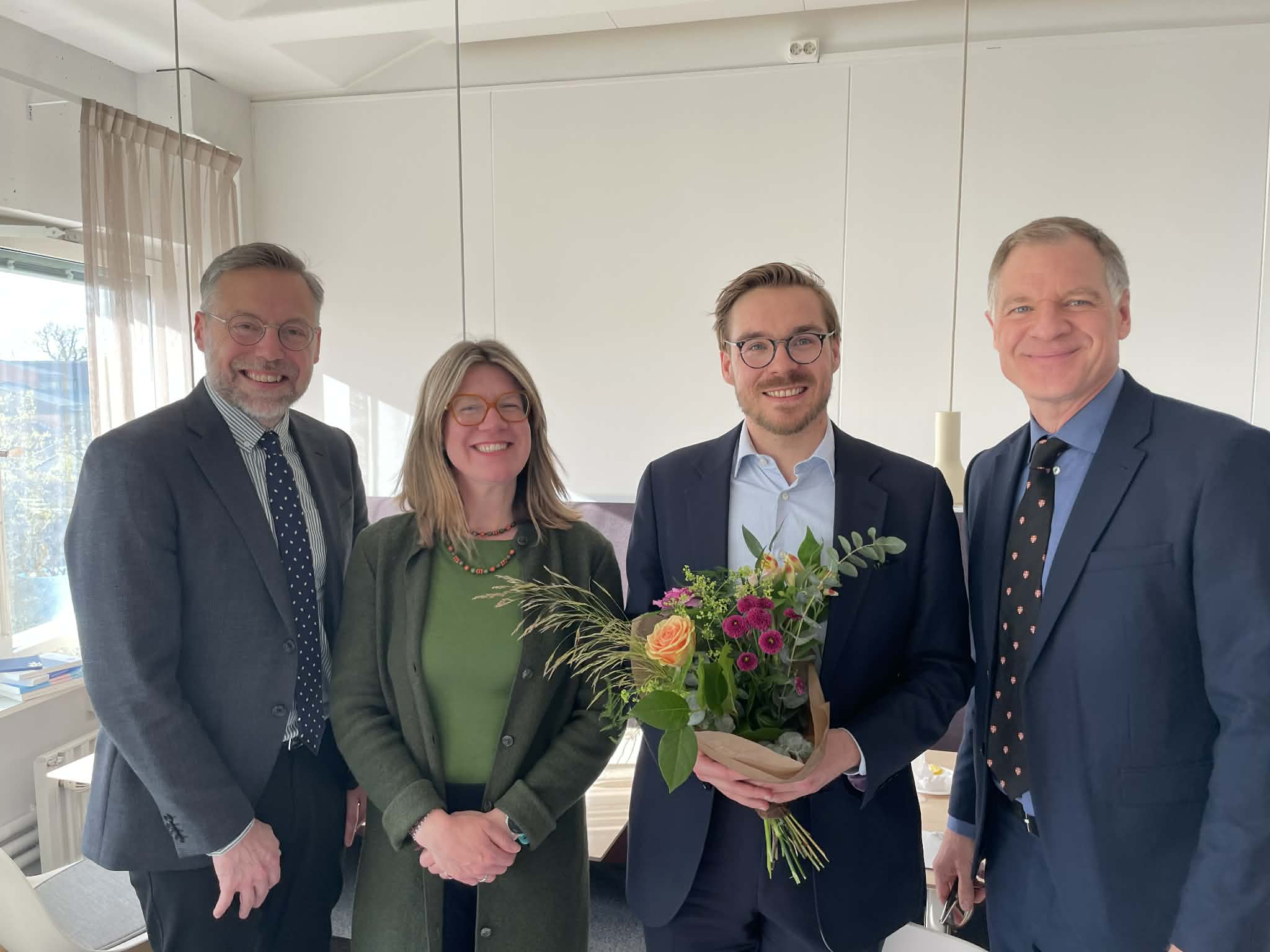
From the left: Supervisor Niklas Bremberg, opponent Kate Sullivan de Estrada, Axel Nordenstam, supervisor Mark Rhinard. Photo: Torkel Gure
Participants
Opponent: Kate Sullivan de Estrada, Department of Politics and International Relations, University of Oxford
Examination Committee Members:
Karin Bäckstrand, Department of Political Science, Stockholm University
Ted Svensson, Department of Political Science, Lund University
Patrik Ström, Centre for Asian Studies, Stockholm School of Economics
Substitute: Magnus Petersson, Department of Economic History and International Relations, Stockholm University
Chair: Maria Wendt, Department of Economic History and International Relations, Stockholm University
Supervisor 1: Mark Rhinard, Department of Economic History and International Relations, Stockholm University
Supervisor 2: Niklas Bremberg, Department of Political Science, Stockholm University
About the thesis
Asbtract
India’s political leadership has expressed green ambitions for several years, yet officials continue to face difficulties implementing these ambitions in practice. This dissertation examines how India’s green ambitions shape the everyday practices of the Indian Foreign Service. It challenges a common tendency in International Relations scholarship to treat status primarily as a motive for foreign policy behavior. Instead, it shifts the analytical focus from political leaders to the ways in which officials manage status considerations in bureaucratic and diplomatic practice.
The dissertation asks two questions: How do dilemmas inherent in India’s green ambitions manifest themselves in the everyday practices and social interactions of the Indian Foreign Service? And how do these manifestations shape the ways in which the Indian Foreign Service represents and advances India’s climate foreign policy at home and abroad? To address these questions, the dissertation develops a practice-oriented analytical framework that reconceptualizes status dilemmas as social processes and applies practice tracing to examine how they unfold in diplomatic practice. The framework centers on a “status dilemma triangle” consisting of three interrelated tensions: recognition tensions, normativity tensions, and epistemic tensions.
Methodologically, the dissertation employs practice tracing to analyze how diplomats interpret and manage these tensions in everyday diplomatic practice. Based on fieldwork primarily in New Delhi, the empirical analysis draws on elite interviews, press releases, and various documents. Empirically, the dissertation examines the operational challenges and day-to-day diplomatic work through which Indian officials navigate green ambitions in international settings. It focuses on three arenas of contemporary climate diplomacy: India’s participation in the UN climate negotiations (including COP27 and COP28), India’s G20 presidency, and India–EU climate relations in the run-up to the 16th India-EU summit, particularly disputes surrounding the EU’s Carbon Border Adjustment Mechanism and sustainability clauses in trade negotiations.
The findings demonstrate how India’s green ambitions generate complex status dilemmas for officials navigating competing expectations and pressures. The dissertation identifies diplomatic strategies through which officials manage such dilemmas, offering insights relevant to research on climate diplomacy, diplomatic practice, foreign policy analysis, Indian foreign policy, and status in International Relations.
Last updated: 2026-04-28
Source: Department of Economic History and International Relations