


Conference on Avant-Garde and Migration brought together researchers from around the world
Around 280 scholars, art historians and researchers from across the globe gathered at Aula Magna last week for the interdisciplinary conference Avantgarde and Migration.
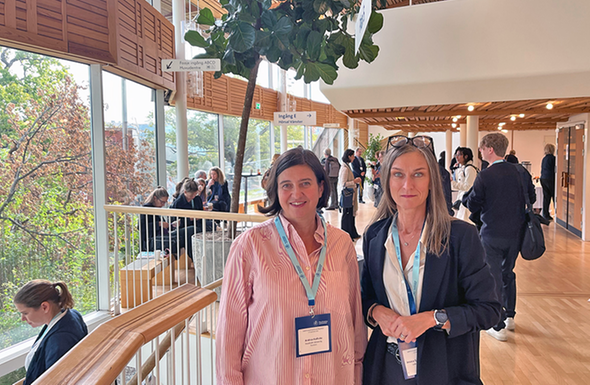
Professors Andrea Kollnitz and Jessica Sjöholm Skrubbe.
The conference was organised by Andrea Kollnitz, professor of art history at the Department of Culture and Aesthetics at Stockholm University, and Jessica Sjöholm Skrubbe professor of art history at Linköping University.
The event featured more than 80 sessions across up to ten parallel tracks, focusing on artistic avant-gardes, migration, and international networks.
For several intensive days, Aula Magna was filled with researchers representing a wide range of disciplines. Avantgarde and Migration forms part of a recurring international conference network dedicated to avant-garde studies, with a new theme explored at each conference.
This year’s theme, migration, was particularly fitting, as movement across borders and international encounters have always been central to the history of the avant-garde.
“The avant-garde has always been mobile. Historically, many of these movements were built on transnational networks and cross-border encounters. When people, ideas and artistic expressions meet, new creative impulses often emerge,” says Jessica Sjöholm Skrubbe.
The theme also resonates strongly with contemporary developments in society.
“What is happening in the world today is reflected in the conference theme. Migration is not only a historical issue but also a highly relevant contemporary one. It is therefore essential for understanding both the history of the avant-garde and its significance in our own time,” says Andrea Kollnitz.
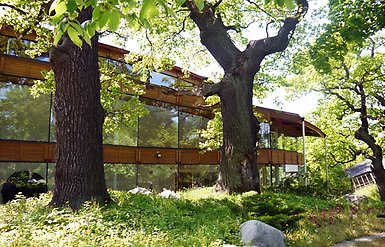
The conference took place in Aula Magna at Stockholm University campus.
Participants travelled from many parts of the world, broadening perspectives and creating opportunities for new research collaborations.
“International exchange increases understanding and openness within research. For scholars, international networks and collaborations are a vital part of academic work, and we depend on these connections to develop new ideas and projects,” says Jessica Sjöholm Skrubbe.
Encounters Spark New Research
The conference provided opportunities for researchers at different career stages to meet and discuss their ongoing work. For the organisers, one of the conference’s most important functions is to create encounters that lead to new collaborations and research initiatives.
“I hope participants return home feeling inspired and that the conference has sparked many new discussions,” says Andrea Kollnitz.
Jessica Sjöholm Skrubbe highlights the strong presence of early-career scholars:
“We have seen a large number of junior researchers taking part, and it is clear that a new generation is entering the field. That has been very encouraging to see.”
Students contributed
The next generation is also emerging at Stockholm University itself. The organising team included three students from the Master’s Programme in Art History and three doctoral candidates in Art History.
“Their participation was both important and rewarding. They made fantastic contributions,” say Andrea Kollnitz and Jessica Sjöholm Skrubbe.
European Network for Avant-Garde and Modernism Studies (EAM)
The European Network for Avant-Garde and Modernism Studies (EAM) is an international research network that promotes the study of the avant-garde and modernism from a global perspective, spanning the nineteenth century to the present day. The network brings together researchers from different disciplines with interests in experimental art forms, literature, aesthetics and cultural history.
EAM organises an international conference every two years. Each conference focuses on a specific theme related to avant-garde studies. Previous themes have included war, globalisation, realism, utopia and crisis.
Last updated: 2026-09-18
Source: Department of Culture and Aesthetics