


PhD defence in Literature: Anna Thörnell
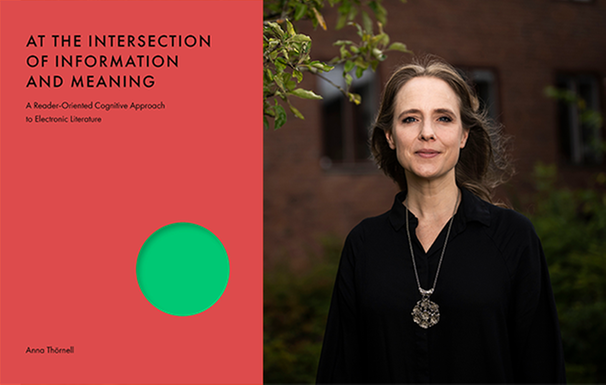
Anna Thörnell defends her doctoral thesis At the Intersection of Information and Meaning. A Reader-Oriented Cognitive Approach to
Electronic Literature.
External reviewer: Hanna-Riikka Roine, Docent in Contemporary Culture Studies and Senior Lecturer in Comparative Literature at Tampere University, Finland.
Examination Committee: Anne Holm, Associate Professor and Senior Lecturer of English at the Department of Languages, Linnaeus University.
Christian Mehrstam, Associate Professor and Senior Lecturer of Literature at the Department of Literature, History of Ideas, and Religion, University of Gothenburg.
Jerry Määttä, Professor of History with a Specialisation in Cultural Studies at the Department of History, Stockholm University.
Per Israelson, PhD of Literature and Senior Lecturer at the Department of Media and Journalism, Linnaeus University. (substitute).
Chair: Carin Franzén, Professor of Literature at the Department of Culture and Aesthetics, Stockholm University.
Supervisor: Thomas Götselius, Professor of Literature at the Department of Culture and Aesthetics, Stockholm University, and Anežka Kuzmičová, PhD of Literature at Charles University, Czech Republic.
About the dissertation
This thesis examines reading electronic literature as a form of information handling. Focusing on the reader as an active subject, it investigates how readers navigate, attend to, retain, interpret, and act upon information – and how these processes shape and are shaped by ongoing meaning making.
Through close analyses of electronic literary works and drawing on literary studies, cognitive science, psychology, neuroscience, linguistics, and media theory, the thesis develops a reader-oriented cognitive approach and four analytical tools: a source-processes model, a framework of integration, an AT · THROUGH · BEHIND triad, and an intrarelational cognitive approach to multiple semiotic resources.
Together, these tools offer new ways of understanding readerly experiences at the intersection of information and meaning, and how electronic literature can make readers experience, through reading itself, what it means to think, perceive, navigate, and make meaning in a digital world.
Last updated: 2026-10-23
Source: Department of Culture and Aesthetics