


Mediehistoriskt arkiv Symposium 2026: Networks, Infrastructures, Systems, and Other Media Connectors. A Marcus Wallenberg Symposium
Welcome to the third of the recurring symposia organised by the Swedish scholarly association Mediehistoriskt arkiv (Media History Archives). Previous events have been held at Uppsala University and Lund University. This year, the symposium is hosted by the Department of Culture and Aesthetics, Stockholm University.
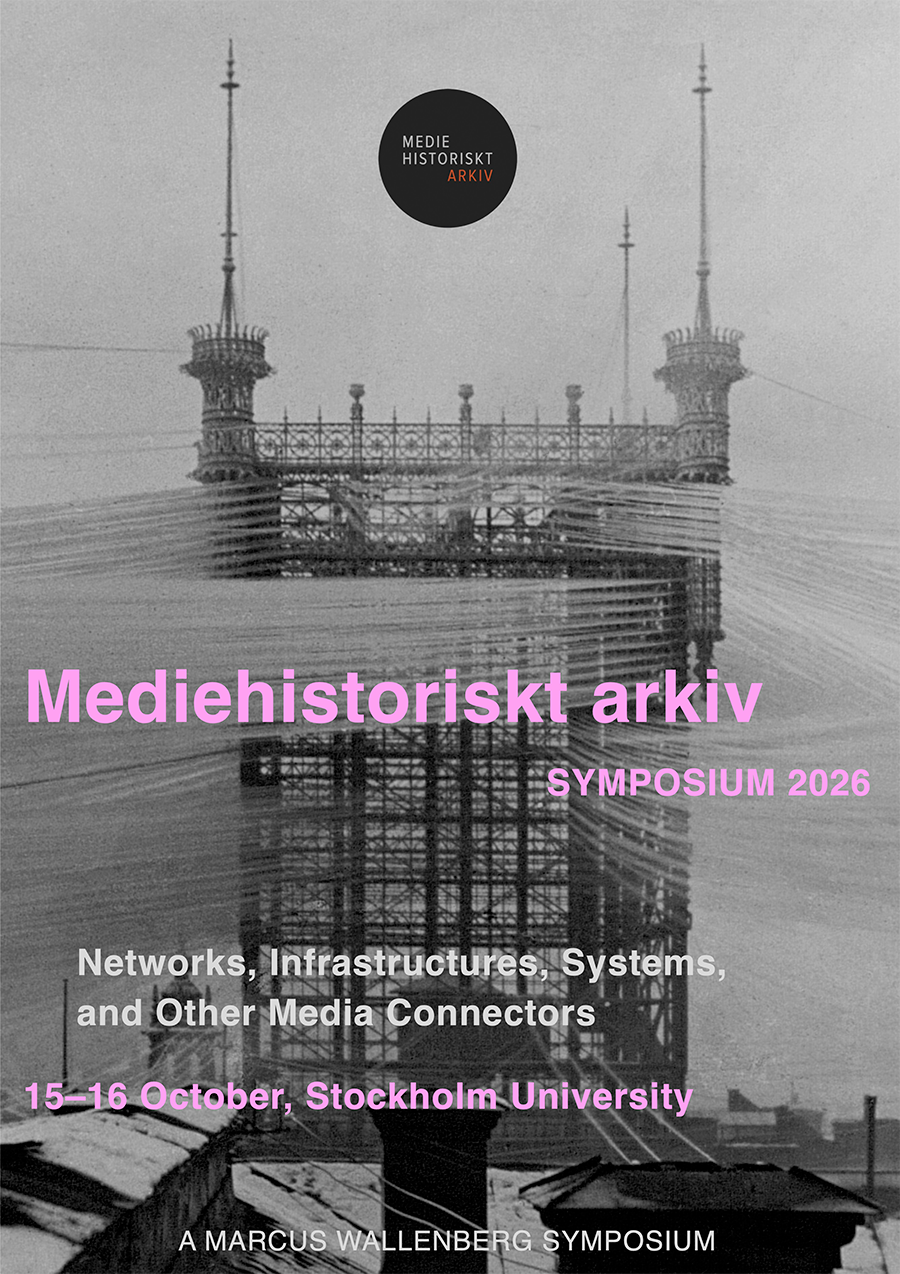
The telephone tower in Stockholm in the 1890s. Unknown photographer. Tekniska Museet, Stockholm (National Museum of Science and Technology, Stockholm).
Confirmed Keynotes
Lori Emerson, Professor of Media Studies, Director of Graduate Studies, and Director of the Media Archaeology Lab, University of Colorado Boulder
Visit Lori Emerson's profile page on University of Colorado Boulder
Tiago de Luca, Professor of Film Studies, University of Warwick
Networks, Infrastructures, Systems, and Other Media Connectors
Networks, infrastructures, systems, ecologies, and similar concepts have become central to media-historical studies. What these terms share is a function as media connectors. They link media across temporal, spatial, and disciplinary boundaries. Whether at a global or local scale or over longer or shorter time spans, research that engages with these concepts sheds light on how media operate within interconnected structures. Here, media should be understood in the widest possible sense, encompassing objects (such as photographic prints, books, or manuscripts), display devices (loudspeakers, projectors, digital screens), and storage media (film reels, vinyl records, cloud servers). It may also refer to elements within larger media systems, such as electronic signals, fibre-optic cables, and radio waves, or to media practices, including, for instance, the logistics of news agencies, the writing, sending and circulation of letters, or the collecting of digital and analogue photographs. Finally, it includes all the users, developers, artists, audiences, and distributors across different historical periods and cultural contexts.
By focusing on the broad and fundamental issue of media connectors, this symposium both wishes to reflect the diversity of media-historical research and to promote a methodological discussion that enables us to understand past and present media in new ways. We welcome contributions from scholars across disciplines who wish to engage with conceptual and empirical explorations of media connectors—their historical operations and effects as well as their epistemological implications. Possible points of inspiration include, but are not limited to:
- Connections across borders, whether across different academic disciplines, national media landscapes, epistemic cultures, or political and cultural fields.
- Relations between macro- and micro-levels, exploring how individual media elements function within larger infrastructural and systemic formations.
- Temporal connections, considering old and new media interrelations, anachronisms, media parallelism, historical change, media persistence, and obsolescence.
- The materiality of media infrastructures, including physical, technological, and logistical structures that enable media networks.
- Alternative or counter-networks, exploring subversive, underground, or non-hegemonic media formations that challenge dominant infrastructures.
- Relations between human and non-human agents in sustaining media infrastructures.
- Aesthetics of media connectivity, considering how artistic forms reflect, critique, or experiment with media interconnections.
- Meta-reflections on conceptual frameworks, analysing how networks, infrastructures, systems, and related concepts function as methodological tools and metaphors in media-historical research.
Programme
Registration
The symposium is free of charge and open to all but requires registration with an e-mail to: sonya.petersson@arthistory.su.se
Venue
The conference takes place at the Auditorium, Department of Culture and Aesthetics, Frescativägen 24 E.
To get to Stockholm University, you can travel by underground (tube/metro) from the central station in Stockholm. Take the northbound red line to Mörby Centrum and get off at the station Universitetet. The journey takes about 10 minutes.
From the station at campus, it is a one-minute walk to the Department of Culture and Aesthetics. Turn left when you exit the station. Walk towards the red-brown brick buildings, entrance 24 E (main entrance). The Auditorium is on the first floor.
Organising Committee
- Sonya Petersson, Research Fellow of Art History, Stockholm University
- Johan Klingborg, Assistant Professor of Swedish Literature and Culture, University of California, Berkeley
- Elina Druker, Professor of Literature, Stockholm University
- Elin Franzén, Research Fellow of Ethnology, Stockholm University/Postdoc researcher in Media and Communication Studies, Södertörn University
- Staffan Bergwik, Professor of History of Ideas, Stockholm University
Funding
The symposium is funded by generous contributions from Marcus Wallenberg Foundation for International Scientific Collaboration, The Magnus Bergvall Foundation, The Sven and Dagmar Salén Foundation and the Department of Culture and Aesthetics.
About Mediehistoriskt arkiv
Mediehistoriskt arkiv (Media History Archives) publishes media related research from all over Sweden and includes anthologies, monographs, and collections of sources. The book series was founded in 2006 by Pelle Snickars at the Swedish National Archive of Recorded Sound and Moving Images; then moved with Snickars to the National Library of Sweden – and was finally transferred in 2014 to Lund University with Patrik Lundell as editor. Since 2019 the non-profit association Föreningen Mediehistoriskt arkiv is the publisher of the book series – with Andreas Nyblom as editor. Mediehistoriskt arkiv publishes titles in both Swedish and English. All titles can be accessed here:
Last updated: 2026-10-12
Source: Department of Culture and Aesthetics