


Thesis defence: Shubham Vaishnav
Welcome to a thesis defence at DSV! Shubham Vaishnav explores how AI-based methods can support decision-making in complex, uncertain environments. The PhD thesis contributes to the research subject AI and Data Science.
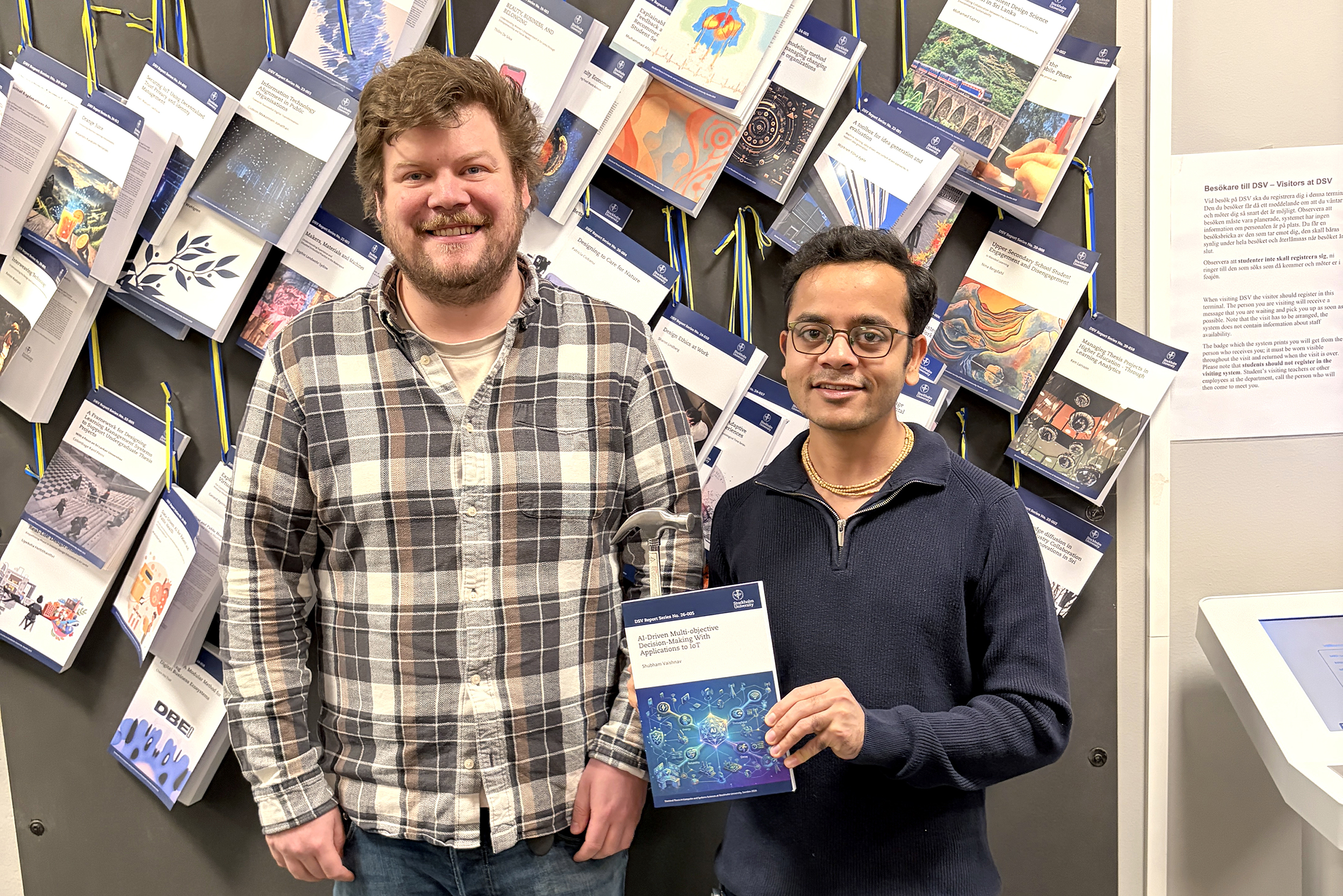
Sindri Magnússon and Shubham Vaishnav at the “nailing ceremony” at DSV.
On 29 May 2026, Shubham Vaishnav will present his PhD thesis at the Department of Computer and Systems Sciences (DSV), Stockholm University. The thesis defence takes place at DSV in Kista, starting at 1:00 pm.
The title of the thesis is “AI-Driven Multi-objective Decision-Making With Applications to IoT”.
PhD student: Shubham Vaishnav, DSV
External reviewer: Salman Toor, Uppsala University
Main supervisor: Sindri Magnússon, DSV
Supervisor: Praveen Kumar Donta, DSV
Abstract
Artificial intelligence (AI) plays an increasingly central role in enabling autonomous decision-making in complex, uncertain environments. Many modern systems must optimise multiple, often conflicting objectives while operating under dynamic resource constraints and incomplete knowledge of system dynamics.
Classical approaches such as dynamic programming, constrained stochastic optimisation, and static multi-objective scalarisation provide principled solutions when accurate models are available. However, in distributed and stochastic environments such as the Internet of Things (IoT), system dynamics are often unknown, non-stationary, and resource-limited, making purely model-based methods difficult to apply.
Reinforcement learning (RL) and online learning offer an alternative by enabling policy adaptation through interaction rather than relying on explicit system models. Within multi-objective settings, existing approaches often assume fixed scalarisation weights or externally specified preferences and typically focus on learning policies for given trade-offs. In dynamic IoT systems, however, both resource constraints and preference parameters may vary over time, requiring algorithms that can adapt efficiently without repeated retraining or centralised coordination.
This thesis investigates how AI-based methods, with a primary focus on reinforcement learning and complementary distributed learning techniques, can support adaptive multi-objective decision-making under communication constraints, explicit resource limitations, and dynamically changing trade-offs.
The research is organised around three themes. First, communication-efficient distributed learning methods are developed to balance model accuracy and communication cost infederated learning through adaptive sparsification. Second, constrained bandit and reinforcement learning formulations are proposed to incorporate explicit and time-varying resource constraints while maintaining theoretical performance guarantees. Third, multi-objective reinforcement learning methods are designed to adapt routing decisions in distributed IoT systems under dynamically changing energy–reliability trade-offs without retraining.
Overall, the thesis demonstrates that integrating communication awareness, constraint handling, and preference adaptation directly into learning algorithms is essential for reliable AI-based decision-making in IoT environments. The results provide both algorithmic advances and a conceptual framework for designing autonomous systems that operate robustly under dynamic objectives and limited resources.
Last updated: 2026-05-21
Source: Department of Computer and Systems Sciences