


Research highlights the preschool hallway as an educational environment
Many hours of everyday preschool life take place in the hallway, but the environment has long received limited attention in research. In her dissertation, Jessica Samsioe examines how getting dressed and undressed, moving around, and encounters in large preschool halls are organized, as well as what significance they have for children's learning and development.
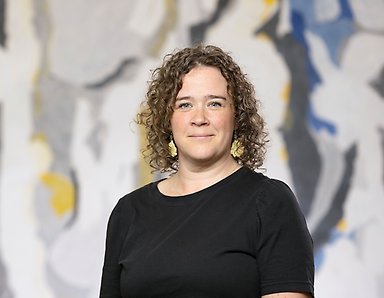
Jessica Samsioe.
- In short, it’s about everyday life in the preschool hallway and the movements in and out of the hallway, from the yard, classrooms, and changing rooms. And how people navigate a spatial environment in relation to the time aspects they have at their disposal in relation to the preschool’s overall organizational structure, says Jessica Samsioe.
The study is based on ethnographic fieldwork with observations, interviews with educators and guardians, as well as so-called walk-throughs where children were allowed to show and talk about their experiences of the hallway. Through this, different perspectives have shed light on how the space is used and experienced.
- I didn’t think the interviews were enough, so I also wanted to involve the children through walk-throughs with them. There I chose to ask if they wanted to show me what they liked to do in the hallway. So we walked around. Which has meant that I’ve played hide and seek in the hallway quite a few times, we’ve sat and read a lot of books, and we’ve pulled on doors that were locked because they were Cleaning closet (probably where a troll lives). The children have shown their shelves and places they like to be or why they don’t like being in the hallway, says Jessica.
A key finding is that the hallway is much more than just a passageway. Even though it is often perceived as stressful, educators consciously work pedagogically through recurring actions, instructions, and routines. The youngest children get a lot of support with dressing and undressing, while older children gradually develop independence and manage the tasks on their own.
- I build my entire dissertation and research design on a constructivist-based theory as a research method, developed from Kathy Charmaz’s further development of Glaser and Strauss’ grounded theory from 1967. It’s about conducting a qualitative empirical study with fieldwork where you perform an empirically driven analysis, says Jessica.
In the dissertation, the concept of didactic rhythms is introduced, which describes the recurring patterns and routines through which children learn differently skills. For the concept, she has drawn on Henri Lefebvre's rhythmanalysis and Sören Högberg's connection to them as educational rhythms. By repeating actions, for example hanging up clothes or pulling up a zipper, children develop both practical and social skills. The work of educators differs from that of guardians in that it has clear learning goals linked to the activities based on their profession.
The study also shows that large preschool halls create unique conditions. They require more planning and organization to avoid feeling stressful, but at the same time, they serve as a central meeting place where children, educators, and guardians come together. The hall contributes to social community, allows for spontaneous interactions, and creates a sense of connection in the preschool.
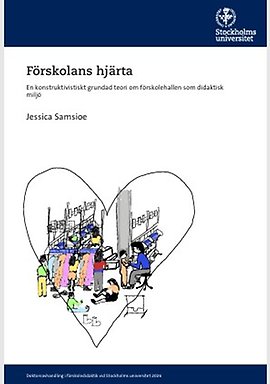
Cover for the thesis.
A surprising result was that relatively few conflicts occurred during the roughly 280 hours that Jessica Samsioe observed the hall. The teachers' way of dividing up the groups of children and creating structure contributed to smoother flows and fewer conflicts, despite cramped spaces and many people in the same place.
- There were surprisingly few conflicts that involved raised voices, arguments, and that type of conflict where you just couldn't make up. The ones that did occur were about the fact that there are many people in a small space, making it very difficult to keep track of where all the children were in various situations. I think the reason there were relatively few conflicts is that these teachers tried to establish the rhythms I describe, to create a flow, and in that flow, there are fewer conflicts, says Jessica.
The dissertation shows that the work in the preschool hall is not just about logistics and routines. The hall serves as an important educational environment where children develop independence, responsibility, and social skills. Therefore, the hall should be seen as a central part of the preschool's teaching and as a place with great didactic potential – a real 'heart' of the preschool's activities.
The dissertation defense will take place on 13/11 at 1:00 PM, at the Department of Child and Youth Studies, Svante Arrhenius väg 21A, Stockholm University.
Last updated: 2026-10-27
Source: Department of Child and Youth Studies