Harmful chemicals in our clothes may soon be a thing of the past, thanks to a groundbreaking method developed by researchers at Stockholm University. A new method has been developed led by Professor Ulrika Nilsson, which is proposed to become the European standard for monitoring harmful substances in textiles.
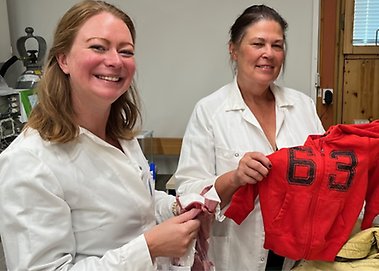
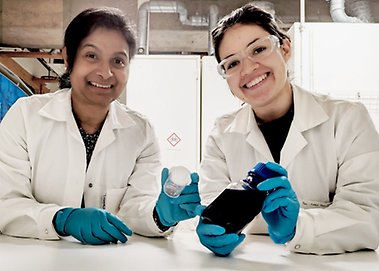
Using forestry residues and textile waste, researchers at Stockholm University have developed a method to produce textiles with a significantly lower environmental impact. The method involves replacing cotton and polycotton, a mixture of both cotton and polyester, in textiles by reusing residues from both textile and forestry waste. “Cotton itself is a very good material and everyone wants to use it, but it has a heavy environmental impact because growing it requires a lot of water and a lot of land,” says Aji Mathew, Professor of Materials and Environmental Chemistry. In the first instance forest waste, that includes tops, branches and infected shoots from trees, is used. Textile waste is then also utilized. The material used is what is available in Sweden to create a new high-quality material. In the laboratory, the process starts by putting forestry residues into a chemical process to extract high-quality textile fibers. Once the plant fibers are obtained, the next step is to spin them into lyocell fiber. This process is done in collaboration with an industrial partner. The second phase of the process focuses on improving these lyocell fibers. Here, nanosized cellulose is used, which are small particles extracted from cellulose in textile waste. This nanocellulose is applied as a coating around the lyocell fibers to increase their mechanical strength and functionality. This step is crucial to maximize the usability and durability of the resulting fibers. The work is being conducted in collaboration with Region Stockholm and focuses on identifying alternatives to cotton and polycotton, materials currently used in healthcare in the region. “We have evidence that it is possible, so what we need to do is a full life cycle assessment to investigate the extent, but the hope is that we can reduce the use by 50% of these cotton and polycotton materials,” says Aji Mathew.
Stockholm University Center for Circular and Sustainable Systems − SuCCESS
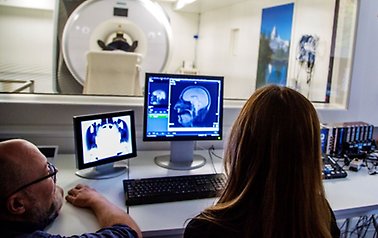
Tens of thousands of unknown chemicals surrounds us. Most are harmless, but some are harmful to our health and the environment. Anneli Kruve at Stockholm University has received a five-year EU grant to develop an AI model that can quickly determine which chemicals in a sample are potentially toxic.
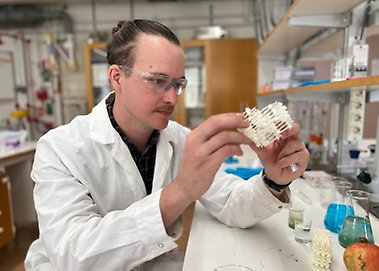
Researchers from Stockholm University have developed porous crystals made from pomegranate extract to capture and degrade pharmaceutical molecules found in local municipal wastewater. The article was first published 22 February 2024. Pharmaceutical compounds affect the human body to improve our health, but they can also have unintentional adverse effects for the wellbeing of wildlife. Hence wastewater treatment plants are facing the challenge of removing emerging organic contaminants (EOCs) such as active pharmaceutical ingredients, and therefore new materials and technologies are required. One strategy for removing pollutants from water is by using porous materials that behave like sponges. Metal-organic frameworks, so called MOFs, are a type of nanoporous material that are made of metal ions and organic molecules. Most MOFs are made using synthetic organic molecules. But now researchers from the Department of Materials and Environmental Chemistry, Stockholm University, have managed to develop new porous MOFs using a naturally occurring molecule found in plants – ellagic acid. “Ellagic acid is one of the main building units of naturally occurring polyphenols known as tannins, which are common in fruits, berries, nuts, and tree bark. By combining ellagic acid, which was extracted from either pomegranate peel or tree bark, with zirconium ions, we developed a new highly porous MOF which we named SU-102,” says Erik Svensson Grape, who did the study during his time as a PhD student at the Department of Materials and Environmental Chemistry, Stockholm University.
Eutrophication is the gradual increase of nutrients such as phosphorus (P) and nitrogen (N) in lakes and seas. While N can re-enter the ecosystem via the natural nitrogen cycle, there is no natural remedy for P, and unless physically removed, P stays in the aquatic environment forever. Therefore, the removal of P from eutrophicated systems is of utmost importance.
Knut and Alice Wallenberg's foundation appoints 31 Wallenberg Academy Fellows this year, one of them is MMK associate professor Mika Sipponen! These prestigious funds will cover research over five years. After the end of the first period, it is possible to apply for another five years of financing. Mika Sipponen will lead reseach on creating living materials for water purification and carbon fixation. Read all about the plans on the Knut and Alice Wallenberg Foundation webpage
Researcher affiliated with one of Stockholm University’s departments are welcome to apply for SUBIC research grants. Application deadline is December 11th.
Co-organized by the Scientific Office of the Italian Embassy and the University of Stockholm, the Bioelectronics and Sustainability symposium was held in Stockholm on 26 and 27 October 2023. This bilateral meeting was coordinated by Augusto Marcelli, scientific attaché in Stockholm, and Erica Zeglio, Assistant Professor and WISE Fellow at the Department of Materials and Environmental Chemistry at Stockholm University, and was hosted in its new headquarters at the Albano Campus.
Berit Olofsson, Professor in Organic Chemistry, and Chair of the SUCCeSS board has been eleceted to be part of the advisory board of the journal, Chem.
Professor Aji Mathew and her research group at Stockholm University are finding solutions to upcycle used textiles of both cotton and synthetic fibres.
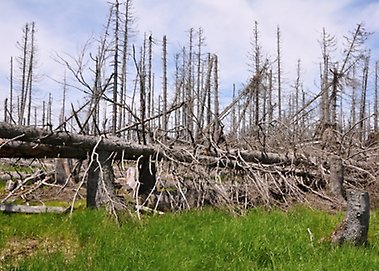
New research shows that wood damaged by bark beetles can be converted into fiber that can replace cotton for several functions in healthcare and biofuels, including for air transport.