


To say a lot with few words: Chinese poetry, interpretation, and the possibilities of translation
What can a few lines of poetry say about an entire society? For Monika Gänssbauer, professor of Chinese language and culture at Stockholm University, the answer is: a great deal.
In her research, literature, history, and language converge in work that often involves reading slowly and carefully. "The Chinese poetic tradition aims to convey as much as possible with as few words as possible," she says. It's a tradition where every word carries multiple layers of meaning and where much of the content lies between the lines.
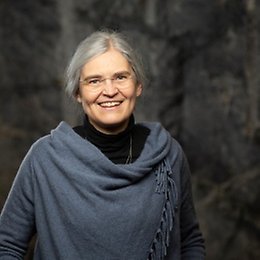
Monika Gänssbauer is professor of Chinese language and culture at Stockholm University.
Poetry instead of epics
In many cultures, there are grand epic tales that shape a shared history. In China, poetry took on a similar role. "Early China lacks the kind of epics found in many other cultures," says Monika Gänssbauer. "Instead, the poetry collection 'Shijing', or 'The Book of Songs', holds a central place."
This classic collection contains texts ranging from love and family life to politics and society. The poems connect people and generations: the living honor their ancestors, history reflects the present, and ordinary people can both praise and criticize their rulers. A classic commentary on the collection states, "The intention dwells where the poetry goes." Thus, poetry is seen as both an expression of human inner feelings and a way to shape them.
Poetry as guidance in life
The fact that poets from the Tang and Song dynasties are still read and quoted is not surprising, according to Gänssbauer. "I believe that people all over the world find solace in literature and poetry from different times. It can help us put things into perspective and understand our own experiences."
She refers to author Jeanette Winterson, who describes literature as a language powerful enough to express how the world truly is. Poetry, Winterson writes, is not a hiding place. It's a place of discovery. Love poems are among the most timeless. "Love poetry is a perennial favorite," says Gänssbauer.
A mirror of society
Historically, poetry was also closely linked to education and power. For a long time, access to state offices was determined by extensive exams on classical texts rather than administrative knowledge. "The imperial civil service exams did not require administrative knowledge but a deep familiarity with classical works, including poetry," says Gänssbauer.
Poems served as both an art form and a social language. Friends wrote poetry to each other during meetings and farewells. At the same time, poetry could be politically sensitive. "Writing a critical poem could lead to exile or other punishments." A well-known example is the poet Su Dongpo, who sometimes concealed criticism behind female narrators in his poems.
Reading history in a poem
Through poetry, one can also gain insights into historical experiences. A poem in 'The Book of Songs' portrays soldiers protesting against injustices during a military campaign:
"Minister of war! We are the king's claws and teeth. Why have you rolled us into misery, With no place to settle or rest?"
"This is an unusually direct poem," says Monika Gänssbauer. "Often, the expression is more indirect. The Chinese language lends itself well to the elusive and implied."
Translation as interpretation
Part of Gänssbauer's work involves translating Chinese poetry. It is a task where every decision entails an interpretation. "Every translation is an individual interpretation. I would even say that every reading is a form of translation."
The strict structure of classical Chinese poems is often challenging to maintain in European languages. At the same time, she does not believe that anything necessarily gets lost. "Many say that something is always lost in translation. I also think that much can be found." In some cases, a translator can discover meanings that the author did not consciously formulate.
One word – several worlds
An example is the phrase 'kong shan' in a poem by the Tang poet Wang Wei. "One translator wrote 'Empty mountain', another 'So lone are the hills'." But the word 'kong' also holds a Buddhist dimension related to existential emptiness. "How can one convey that meaning in a translation? It is a difficult question."
From classical to modern
During the 20th century, China underwent a language reform that fundamentally changed literature. Most contemporary poets today write in modern Chinese and sometimes distance themselves from the classical tradition. Gänssbauer highlights several modern authors, including Wang Xiaoni, Xi Xi, and Gu Cheng.
The art of reading slowly
For Monika Gänssbauer, working with poetry is also a way to train attention. "The most fascinating aspect is the process of slow reading." She refers to the idea that careful reading is a craft where language is studied with great precision. "Reading, translation, and understanding – together, they form a kind of dialogue."
And right there, in the intersection of language, culture, and interpretation, poetry continues to thrive.
Text and interview: Amanda Gonzalez Bengtsson, Faculty of Humanities.
Last updated: 2026-03-12
Source: Department of Asian and Middle Eastern studies