


Meet Lukas, William and Niki
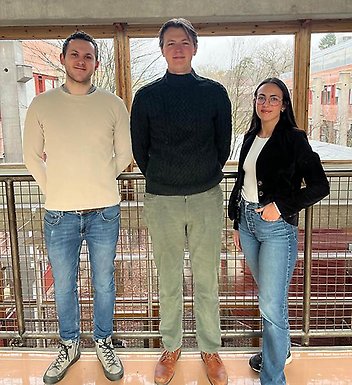
Meet our students Lukas, William and Niki.
%20(2)%20IMG_8074.jpeg)
Lukas, William and Niki.
What was your background before starting the programme and what led you to choose the MSc in Organic Chemistry?
Lukas: I decided to pursue the master’s programme in Organic Chemistry because, during my bachelor’s studies in Chemistry in Austria, I became fascinated by the logic that underlies chemical reactions. I enjoyed understanding why reactions happen the way they do and how small structural changes can completely alter a molecules behaviour.
William: I chose the MSc in Organic Chemistry because I always loved the laboratories for this field, it is a fun mix of practical and theoretical skills that are required to be a good organic chemist. I chose to do my MSc at SU because of the very interesting and diverse research that is done at our department.
Niki: For my Bachelor’s thesis, I worked in the research group of Assistant Professor Jeroen Goos at the Karolinska Institute, where I helped synthesize and develop pharmacological agents for brain-tumor diagnostics and imaging. That experience opened my eyes to organic synthesis and its real world applications. My labsupervisor, Dr. Stefan Milton, showed me to ongoing research and allowed me to observe the full process of early drug development, from initial design to preclinical studies.
Seeing this work up close helped me understand how broad the field of organic chemistry is and how powerful it can be. It showed me that the molecules we design in the lab can eventually become medicines that improve people’s lives. That realization made the field feel meaningful to me, I felt like I had found what I wanted to pursue.
At the same time, I also saw how many other areas organic chemistry connects to, far beyond drug development. That’s why I chose to study organic chemistry: I want to deepen my understanding of synthesis and build the skills to contribute in ways that genuinely matter.
What did you like most about the programme?
Niki: That you are free to build most of it as you like. I wanted to do a lot of practical work in the lab, which this programme allowed for.
William: I liked how much practical experience you get from this program, both in course labs and research labs. I also liked the small class sizes, which meant that we were able to learn a lot from the professors and we could build more personal relationships with them.
Lukas: What I appreciated most about the programme here at SU is how closely it is integrated with the department’s ongoing research. Rather than focusing solely on coursework, a large part of the master’s involves internships and project work in different research groups, which really helps bridge the gap between being a student and becoming a researcher.
What are you doing now, and how has the programme contributed to where you are today?
Niki: I am currently a PhD student in the group of Professor Belén Martín-Matute at Stockholm University. My research curently focuses on developing methods for the synthesis of chiral organoboron compounds. As part of my PhD, I will also work at the intersection of automation and organic synthesis, using high-throughput screening.
I completed my master’s thesis in the same research group, working on carbon capture and conversion. This project gave me my first real experience with research and helped me find my place in Professor Belén Martín-Matute’s group, ultimately opening the door to my PhD studies. I am very grateful for this opportunity and feel fortunate to be part of a research group that is driven and supportive.
Lukas: I am now pursuing my PhD at Stockholm University in the group of Fahmi Himo, where I study the mechanisms of organic reactions using computational chemistry rather than working in the laboratory. My work focuses on using quantum-chemical methods to understand how reactions proceed on a molecular level, which helps explain why certain transformations work the way they do. Making this transition to a new field was made possible largely thanks to the structure of the master’s programme, since the internships and research projects enabled me to explore computational chemistry and gain the experience needed to move into this area for my doctoral studies.
William: I am a PhD student in Joseph Samec's group. The year and a half we got to spend in research labs during the master's program made me realize that I loved doing research, so I would not be a PhD student today if it were not for the MSc in Organic Chemistry at SU.
Last updated: 2026-05-07
Source: Student Services