


The “Donroe Doctrine” and the Future of US-Canadian-European Relations
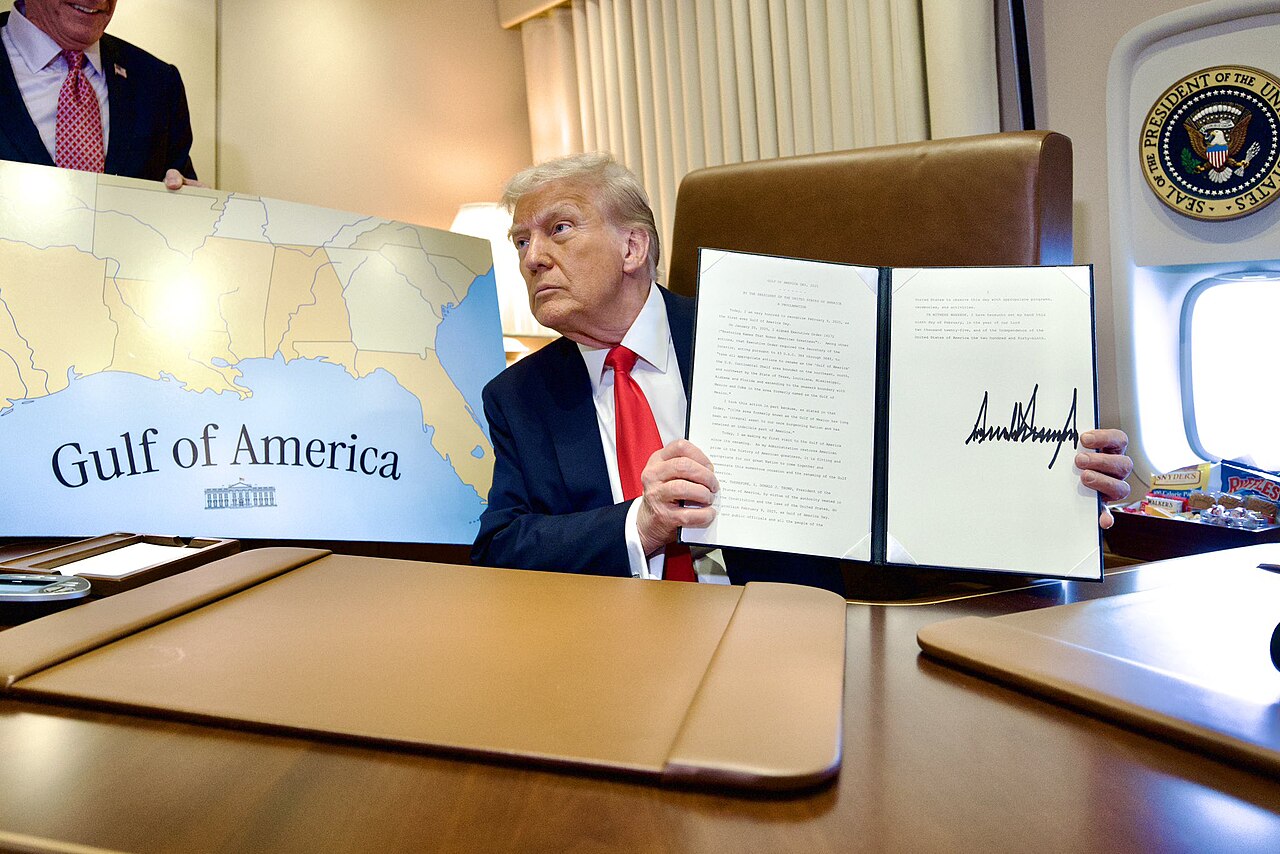
President Donald Trump on Air Force One poses next to a map of the Gulf of America during a flight to New Orleans on February 9, 2025.
David G. Haglund, Professor of Political Science at Queen’s University in Canada will discuss how U.S. strategic thinking is evolving in an era of growing uncertainty. Drawing on the so-called “Donroe Doctrine,” he will examine whether historical experiences of isolationism can offer guidance for the future of relations between the United States, Canada, and Europe.
On May 7, 2026, a hybrid seminar will be held, featuring David G. Haglund as keynote speaker. The event is organized by the Centre for Canadian Studies in collaboration with the Swedish Institute for North American Studies.
The concept of the “Donroe Doctrine” was coined in early 2025 as an ironic—yet revealing—reference to Donald Trump and the strategic vision of his administration. The term alludes to James Monroe and the classical Monroe Doctrine of 1823, which established two key principles: that Europe should refrain from further colonization in the Western Hemisphere, and that this hemisphere should remain a zone reserved for republican forms of government.
For a long time, the Monroe Doctrine came to symbolize U.S. great power strategy, often associated with isolationism—the idea of mutual non-interference between the “Old” and the “New” World. However, during the 20th century, a decisive shift occurred. The United States moved from relative detachment to becoming a central actor in Europe’s security architecture, particularly after the Second World War. With the establishment of NATO, the transatlantic link became a cornerstone of international security policy.
From Franklin D. Roosevelt to Joe Biden, this transatlantic commitment has largely been taken for granted. Today, however, in light of a possible return to a more unilateral U.S. strategy, this foundation is being called into question. The rhetoric surrounding the “Donroe Doctrine” reflects growing concern within the transatlantic alliance about the future role of the United States.
The seminar aims to place these developments in a historical and analytical perspective. What lessons can be drawn from previous shifts in U.S. foreign policy? And what do these changes imply for relations between North America and Europe in a time of geopolitical transformation?
The event will be held in a hybrid format and is open to researchers, students, and anyone interested in international politics and transatlantic relations.
To register for in-person participation, please contact: ccs@su.se
Last updated: 2026-04-24
Source: Department of Romance Studies and Classics